
Watch your mouth.
Your parents may have said that at key moments in your youth when you ventured to utter the unutterable.
The old pastor in the early church said it and his admonition is enshrined in in an epistle by his name, the Book of James.
Guard your tongue, bridle it, and be careful about the words that come forth from your mouth.
They can do a lot of good; they can do a lot of harm.
They are predictors of success and they are revealers of the heart.
Watch your mouth and bridle your tongue. Think before you speak.
— — — — — — — — — — — — — — — —
James 3:1–12
Not many of you should become teachers, my brothers and sisters, for you know that we who teach will be judged with greater strictness. For all of us make many mistakes.
Anyone who makes no mistakes in speaking is perfect, able to keep the whole body in check with a bridle. If we put bits into the mouths of horses to make them obey us, we guide their whole bodies. Or look at ships: though they are so large that it takes strong winds to drive them, yet they are guided by a very small rudder wherever the will of the pilot directs.
So also the tongue is a small member, yet it boasts of great exploits. How great a forest is set ablaze by a small fire! And the tongue is a fire. The tongue is placed among our members as a world of iniquity; it stains the whole body, sets on fire the cycle of nature, and is itself set on fire by hell.
For every species of beast and bird, of reptile and sea creature, can be tamed and has been tamed by the human species, but no one can tame the tongue — a restless evil, full of deadly poison. With it we bless the Lord and Father, and with it we curse those who are made in the likeness of God.
From the same mouth come blessing and cursing. My brothers and sisters, this ought not to be so. Does a spring pour forth from the same opening both fresh and brackish water? Can a fig tree, my brothers and sisters, yield olives, or a grapevine figs? No more can salt water yield fresh.
Fire Out of Hand
Even so the tongue is a little member, and boasteth great things. Behold, how great a matter a little fire kindleth! — James 3:5
There is a negative fire that the tongue can ignite. It is the destructive fire of gossip, malice, slander, and discord.
Keep plenty of water on hand when there is much talk. There is likely to be an inferno arising. Satan will fan the flames and itchy ears will provide the fuel. Before long, lives will be left to ruin and churches will be turned to ashes in the name of speech that might even masquerade itself as prayer requests, concerns, and opinions.
Watch your speech. You may not be able to tame your tongue, but you can give it to God. You can ask Him to catch you before you go too far and to season your words with grace, mercy, and love. You can practice the art of complimenting, edifying, and uplifting in your words. If you are always speaking words of truth in love, you’ll have no time for gossip and negative whispering.
Be more critical of yourself than you are of others. Seek accountability. Ask someone to help you “catch yourself.” Put a rubber band on your arm and snap it every time you are tempted to say something that would not be pleasing to God or nurturing to His people.
Ask yourself, “Does this really need to be said and, if it does, would it be better spoken to God?”
If someone wants to gossip, criticize others, or speak ill of God’s servants in your presence, graciously change the subject. If they persist, say something like, “Call me after you have prayed and spoken to John (or Sally) directly about this. If you still feel this way, we can go to him (or her) together. Until then, I think it is best that we not discuss this.
Stop the fire before it starts.
Sermon Notes
— — — — — — — -
We all have roles to play in God’s story.
These roles all have different characters, but the role of the whole is to bear the image and self-disclosure of God and God’s story in the world.
Therefore, we observe:
- We all long to have something of ourselves to give back to God.
- Everything that we ever have to give comes from God.
- There is a desire to leave something of ourselves in the world and for the world to bless the world.
God hears the prayer that longs for this.
God’s name is made known through those who desire this.
Here is a different cast of character over a long period of time:
Sara, Hannah, Elizabeth, Mary — All had unexpected pregnancies.
One of these wanted nothing more.
Hannah, mother of Samuel, the last of the judges of Israel
— — — — — — — — — — — — — — — — — — — —
Some Background:
- The name Elkanah is a Hebrew name for boys that means “God has purchased” or “God has created”. It comes from the words el, meaning “God”, and qaneh, meaning “to acquire”.
- The name Peninnah is of Hebrew origin and means “pearl” or “precious stone”. It comes from the Hebrew word pəninā.
The name Hannah is a feminine name of Hebrew origin that comes from the root ḥ-n-n, which means “favor” or “grace”. It can also be spelled Hanna, Hana, Hanah, or Chana. - The name Eli is of Hebrew origin and means “high” or “elevated”: Etymology: The name comes from the Hebrew word aliyah, which means “ascent” or “reaching higher ground”
- The name Samuel can mean either God Hears or The Name of God
- Theotokos — God Bearer
- Nazarite — an Israelite consecrated to the service of God, under vows to abstain from alcohol, let the hair grow, and avoid defilement by contact with corpses (Num. 6).
What is produced from our lives, dedicated to God, and released to the world to bear the image of God in the world?
— — — — — — — — — — — — — — — — — — — — -
1 Samuel 1:4–20
Hannah’s prayers answered
On the day when Elkanah sacrificed, he would give portions to his wife Peninnah and to all her sons and daughters, but to Hannah he gave a double portion because he loved her, though the LORD had closed her womb. Her rival used to provoke her severely, to irritate her, because the LORD had closed her womb.
So it went on year by year; as often as she went up to the house of the LORD, she used to provoke her. Therefore Hannah wept and would not eat.
Her husband Elkanah said to her, “Hannah, why do you weep? Why do you not eat? Why is your heart sad? Am I not more to you than ten sons?”
After they had eaten and drunk at Shiloh, Hannah rose and presented herself before the LORD. Now Eli the priest was sitting on the seat beside the doorpost of the temple of the LORD.
She was deeply distressed and prayed to the LORD and wept bitterly.
She made this vow: “O LORD of hosts, if only you will look on the misery of your servant and remember me and not forget your servant but will give to your servant a male child, then I will set him before you as a nazirite until the day of his death. He shall drink neither wine nor intoxicants, and no razor shall touch his head.”
As she continued praying before the LORD, Eli observed her mouth.
Hannah was praying silently; only her lips moved, but her voice was not heard; therefore Eli thought she was drunk.
So Eli said to her, “How long will you make a drunken spectacle of yourself? Put away your wine.”
But Hannah answered, “No, my lord, I am a woman deeply troubled; I have drunk neither wine nor strong drink, but I have been pouring out my soul before the LORD.
Do not regard your servant as a worthless woman, for I have been speaking out of my great anxiety and vexation all this time.”
Then Eli answered, “Go in peace; the God of Israel grant the petition you have made to him.”
And she said, “Let your servant find favor in your sight.” Then the woman went her way and ate and drank with her husband, and her countenance was sad no longer.
They rose early in the morning and worshiped before the LORD; then they went back to their house at Ramah. Elkanah knew his wife Hannah, and the LORD remembered her.
In due time Hannah conceived and bore a son. She named him Samuel, for she said, “I have asked him of the LORD.”
What’s the point of longing foe a son if you are just going to give him back to God under the care of the priest.
Again:
- We all long to have something of ourselves to give back to God.
- Everything that we ever have to give comes from God.
- There is a desire to leave something of ourselves in the world and for the world to bless the world.
— — — — — — — — — — — — — — — — — — — — -
1 Samuel 2:1–10
My heart exults
Hannah prayed and said, “My heart exults in the LORD; my strength is exalted in my God. My mouth derides my enemies because I rejoice in your victory. There is no Holy One like the LORD, no one besides you; there is no Rock like our God.
Talk no more so very proudly; let not arrogance come from your mouth, for the LORD is a God of knowledge, and by him actions are weighed.
The bows of the mighty are broken, but the feeble gird on strength.
Those who were full have hired themselves out for bread, but those who were hungry are fat with spoil. The barren has borne seven, but she who has many children is forlorn.
The LORD kills and brings to life; he brings down to Sheol and raises up.
The LORD makes poor and makes rich; he brings low; he also exalts.
He raises up the poor from the dust; he lifts the needy from the ash heap to make them sit with princes and inherit a seat of honor. For the pillars of the earth are the Lord’s, and on them he has set the world.
He will guard the feet of his faithful ones, but the wicked will perish in darkness, for not by might does one prevail.
The LORD! His adversaries will be shattered; the Most High will thunder in heaven. The LORD will judge the ends of the earth; he will give strength to his king and exalt the power of his anointed.”
— — — — — — — — — — — — — — — — —
The book of Samuel is written years after the events from stories collected and told, most likely, during the reign of King David.
Why, because Hannah is talking about a King when there was no king.
That does not mean that someone put these words in Hannah’s mouth; it just means that they would have had no significance to anyone except God who was going to use Samuel to introduce the first two kings to Israel, one of which would have Messianic significance which would come to rest upon the one who would, in his messianic role, be called the Son of David.
— — — — — — — — — — — — — — — — — -
Additional Thoughts
“Theotokos” means “God-bearer.”
Rachmaninov composed it as a tribute to Mary, who bore the Son of God and in whom God was incarnate, appealing to her prayers on our behalf.
That being said, are you not a God-bearer in whom the Son of God incarnates Himself in the world and through whom He shows His love and compassion for humanity?
Therefore, are you, we, and all of us not called upon to pray for one another this morning? (James 5:16)
To be ever vigilant in prayer? (Colossians 4:2–4)
To be grave conquerors? (Romans 8:37)
There are people who are hoping in our intercessions as we hope in the intercessions of others.
Bear God, this morning, to a hurting world. Bear God as light in darkness. Share His love. Do His bidding. Lift the fallen. Bring hope where there is no hope. Feed the hungry. Heal the sick.
Raise the dead.
Freely, you have received; freely give.

Early, comes morning and only hopeful people venture forth.
The world is dark. Is it?
Then why is it that I see the road before me and little obstacles in my path?
Why is it that I can see if everything is dark?
It must be something else because it is not totally dark.
It is in the balance, and I can see. Can you see.
Brahms walks with me as I walk, awakening the dawn.
He speaks to me through my ear plugs and God speaks through him and …
Bounce, step, bounce, I am on my way, the music, and the bounce and …
The slight light of dawning informs my steps, and I hope
And hope rises and the sun rises, summoned by Composer and Conductor.
The music of the universe awakens the morning and the sun rises and
All is well.
Look not at the darkness; walk in the light you have and keep walking
As the sun rises.
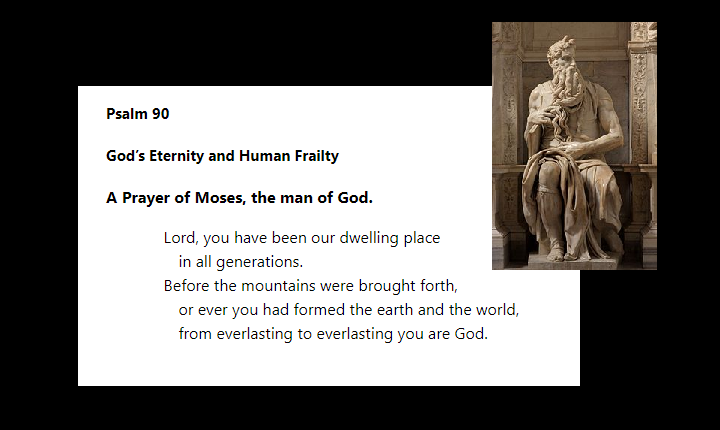
Psalm 90 — God’s Eternity and Human Frailty
A Prayer of Moses, the man of God.
Lord, you have been our dwelling place
in all generations.
Before the mountains were brought forth,
or ever you had formed the earth and the world,
from everlasting to everlasting you are God.
You turn us back to dust,
and say, “Turn back, you mortals.”
For a thousand years in your sight
are like yesterday when it is past,
or like a watch in the night.
You sweep them away; they are like a dream,
like grass that is renewed in the morning;
in the morning it flourishes and is renewed;
in the evening it fades and withers.
For we are consumed by your anger;
by your wrath we are overwhelmed.
You have set our iniquities before you,
our secret sins in the light of your countenance.
For all our days pass away under your wrath;
our years come to an end like a sigh.
The days of our life are seventy years,
or perhaps eighty, if we are strong;
even then their span is only toil and trouble;
they are soon gone, and we fly away.
Who considers the power of your anger?
Your wrath is as great as the fear that is due you.
So teach us to count our days
that we may gain a wise heart.
Turn, O Lord! How long?
Have compassion on your servants!
Satisfy us in the morning with your steadfast love,
so that we may rejoice and be glad all our days.
Make us glad as many days as you have afflicted us,
and as many years as we have seen evil.
Let your work be manifest to your servants,
and your glorious power to their children.
Let the favor of the Lord our God be upon us,
and prosper for us the work of our hands —
O prosper the work of our hands!
Join me for coffee and a psalm . | By Tom Sims | Facebook
Life is a process. Real life is no shallow exercise of mundane motions, but an interwoven tapestry of threads that journey through, across, and deep within the relationships of many threads and weaves until a unity emerges.
Here is Psalm 90 (KJV) with an Ives setting to listen to as you read if you can read and listen to Ives at the same time.
Charles Ives is not for musical cowards or spiritual wimps. He captures the ambiguities and resolutions of faith at a level that is often contradictory to the cursory view, but is, in fact, in perfect harmony with the realities of divine providence and direction.
Life is not a steady slope. Nor is it always a clear path, but the Lord is our dwelling place in the midst. He teaches us to number our days. He multiplies the work of our hands.
He is with us.
When We’ve Been There Ten Thousand Years Bright, Shining as the Sun
For a thousand years in thy sight are but as yesterday when it is past, and as a watch in the night. — Psalm 90:4
But, beloved, be not ignorant of this one thing, that one day is with the Lord as a thousand years, and a thousand years as one day. — II Peter 3:8
Where will you be a thousand years from now? Ten thousand? A million? A billion?
We live in time and space and are subjected to the limitations of such. Time is depleted and never regained. Not so in our Father’s house. There will be no wasted moments or years. There will be no waiting, no boredom, and no hurry.
Time will be turned upside down, inside out, and all around. It will be but a faded memory. Eternity, of which we are now at least somewhat ignorant, will be as real as the second hand is today. What is incomprehensible will be comprehended. What is vast will remain vast, but our capacity to experience it will be transformed.
We may not comprehend it, but we don’t have to be ignorant of it either. We can at the very least, know this: There is so much that we do not know now, but someday we will know fully even as we are now fully known.
It is about becoming eternally minded, living every day with eternity in our focus, in our hopes, and in our hearts. We are called to live on a different plane with an attitude of amazement.
“While we look not at the things which are seen, but at the things which are not seen…” is how Paul put it in II Corinthians 4:18. It is a matter of choosing our view and sticking with it.
Can you imagine bright shining as the sun for eternity? I can’t either, but I can wait a little longer for it with the wonder with which a child waits for Christmas. Now is the time to make decisions for eternity because this is all the time anyone will ever have.
This is all the time that ever will be. We are about to step out of this realm into the timeless expanse of eternal glory. We are about to leap into God’s everlasting day.

Here is the prayer of a maturing heart to be prayed in our youth.
It is the prayer that we would be aware of the fragility of time, the shortening of days, and the seriousness of our sinful wastefulness.
It is the plea that we might embrace our suffering and discipline as part of God’s love and our maturing process.
It is the petition that we would learn to be glad, that we would see with a broader deeper, and more eternal perspective, and that we would be satisfied with God’s love.
The result, by grace will be the favor of God as shown in His blessing upon our work, His power in and through us.
Amen.
“ So teach us to number our days
that we may get a heart of wisdom.
Return, O LORD! How long?
Have pity on your servants!
Satisfy us in the morning with your steadfast love,
that we may rejoice and be glad all our days.
Make us glad for as many days as you have afflicted us,
and for as many years as we have seen evil.
Let your work be shown to your servants,
and your glorious power to their children.
Let the favor of the Lord our God be upon us,
and establish the work of our hands upon us;
yes, establish the work of our hands!” - Psalm 90:12–17 (ESV)
Like many of you, I value work. I like to work. I enjoy the results of my work. I put my heart and soul into my work. I see God at work in my work. I want to keep working as long as I possibly can. I desire to see the work of my hands make a difference. It is always good to find a prayer with which I can agree in bringing these desires before God.
“ Let the favor of the Lord our God be upon us,
and establish the work of our hands upon us;
yes, establish the work of our hands!”
Let’s talk.
tomsims | Instagram, Facebook, TikTok | Linktree

The N Word in Networking
When I am doing acronyms, I often run out of words that start with the letter “N.” So, in preparing to write about tips for networking and key words to prompt thinking, I did a little bit of thesaurus work.
Behold! I found so many “N” words that I soon realized I would never get to “E” in one article.
So, I decided to go with the flow … just like when I am networks.
Here are some words and thoughts on networking starting with the letter “N.”
Name — Learn to learn names and use them when talking with people. People love to be called by name.
Net — The net in network reminds us that we are already woven as a net with our interests, relationships, and common needs. When we know that, we can cast a broader net to include more people in our circle of influence.
Nest -When appropriate, a great way to network is to invite people into your home informally. Get to know them better. Include them in larger gatherings or just share a meal.
Noise — Noise is generated when you step forward and say the first words. You are probably going to have to learn to take initiative in meeting people.
Novel — This may be novel to you. You may not have done it before. Don’t be terrified. Others have had to start from scratch too.
Niche — Start with familiar territory where there are people who share you interests or whose interests overlap with yours. it will be easier to start conversations and find common ground for more meetings.
Natural — Keep in natural. That means no script, no agenda, no preconceived outcomes. Networking is about meeting people and then, discovering where those meeting lead. When it is natural, it is genuine. You show that you are genuinely interested in people as people.
Number — It is a numbers game. The more people you meet, the more likely it is that you will meet people you can help or who can help you.
Navigator — You can network by making yourself available as a navigator for people entering new territory in their lives or businesses. Show them the lay of the land, provide resources and information. Introduce them to people they need to know and who need to know them.
Neighbor — Remember that you are meeting a neighbor and we have the privilege of being good neighbors. There is always common ground if we will expand our view of our neighborhoods.
Normal — Networking is a normal part of life. We are made for community and very little success happens in isolation.
Need — Be a resource for meeting needs. Orient yourself toward that end. If you are willing to serve, you will find people happy to help you get your needs met.
Narrate — Tell your stories. Also, if you meet someone who is in a new setting, help them understand what is happening around them. Tell the story of the place or organization.
Notice — Notice people in a room that are by themselves or not engaged. They have already noticed that they are unnoticed and they are uncomfortable. Help them feel more comfortable.
Notate — Make mental notes and, perhaps, written notes to remind you of the people you met and some of the points of their stories. If possible, never leave a conversation without some contact information or means to continue the conversation.
Nurture — Be a healthy and nurturing presence in people’s lives. Always seek to add value. Also, nurture the relationship with follow up contacts.
Notify — Be a source of communication about events, resources, workshops, meetings, seminars, and other pieces of information that you think someone may find beneficial. Be valuable as a source of information.
Nourish — Have lunches and coffee breaks with people that you initiate or they initiate.
Negotiate — When the time is right, there may be an opportunity for trading services.
New — Meet new people every day. I mean every day.
Near — Look around you. Some folks are closer than you think. Know the people in businesses near you.
Nice — It goes without saying to be nice.
Noisy — You do not have to be loud. You should never be pushy. Lower your voice and slow down your pace to something relaxed. You are networking, not selling.
Narrow — Narrow your focus if it is too broad. The opportunities are boundless. Be strategic about where you spend your time.
Nervous — Find out what helps you with your anxiety about all of this. What self-talk calms and reassures you? Do you need a partner in the beginning? Do you need to brief and debrief with a coach or mentor?
Necessary — This is absolutely necessary to your goals. You need to do it. It is not play time. It is not optional. It is part of your business or profession.
Nonchalant- It is almost like being natural, but it emphasizes being relaxed and casual. Perhaps we cannot say it enough. Relax. Have fun.
Narrative — Build your own narrative of your life and experience that you can condense into a few words. Be prepared to tell about yourself quickly and honestly in a way that makes your new friend want to know you better and ask more questions. That means prepare so that you don’t end up talking too much about yourself.
Nostalgic — I can be pretty nostalgic about networking because I have met so many people “accidently” who have come to be very significant in my life.
You can too.
Lesson from “The Music Man”

A con man came to town.
He came with one goal in mind. He wanted to empty people’s savings, line his pockets, and get out of town.
But two things surprised him: love and music.
And they were entangled with each other in the way that they are always entangled. Each one informs and prompts the other.
Music and love are both transformative.
They are also medicinal.
But how can we persuade the world to take its medicine?

Where did the food come from when the 4000 were fed?
Wild answer — It does not matter.
We are not told. It is not a major point of the story.
Or — the point of the story might be that we don’t know and do not have to know when we are called to feed the multitudes.
Here are some major points:
- They were amazed, and they praised the God of Israel. (God was already at work.)
- “I have compassion for the crowd.” (The heart of Jesus is compassion)
- Jesus expressed that he did not want to send them away hungry. (He is compelled, by compassion, to do something.)
- “How many loaves have you?” (He starts with an assessment of what is already in their hands to do and to give.)
- “Then ordering the crowd to sit down on the ground …” (He started. It was an act of faith that some might call a risk).
- “…giving thanks….” (He focused on abundance rather than lack).
- “And all of them ate and were filled; and they took up the broken pieces left over, seven baskets full..” (Somehow, all the needs were supplied with more to spare and …)
… and wherever the food came from, it was a miracle.
- and then he kept moving, not resting on glories.
Matthew 15:29–39:
After Jesus had left that place, he passed along the Sea of Galilee, and he went up the mountain, where he sat down. Great crowds came to him, bringing with them the lame, the maimed, the blind, the mute, and many others. They put them at his feet, and he cured them, so that the crowd was amazed when they saw the mute speaking, the maimed whole, the lame walking, and the blind seeing.
And they praised the God of Israel.
Then Jesus called his disciples to him and said, “I have compassion for the crowd, because they have been with me now for three days and have nothing to eat; and I do not want to send them away hungry, for they might faint on the way.”
The disciples said to him, “Where are we to get enough bread in the desert to feed so great a crowd?”
Jesus asked them, “How many loaves have you?”
They said, “Seven, and a few small fish.” Then ordering the crowd to sit down on the ground, he took the seven loaves and the fish; and after giving thanks he broke them and gave them to the disciples, and the disciples gave them to the crowds. And all of them ate and were filled; and they took up the broken pieces left over, seven baskets full.
Those who had eaten were four thousand men, besides women and children. After sending away the crowds, he got into the boat and went to the region of Magadan.

Contemporary slang dictionaries define “woke” as ‘politically and socially aware.’
I would like to propose another perspective on what it means to me as a student of scripture.
To me, this is what it means to be a “woke” person of faith:
They had abused rights, privileges, and others historically if not personally. They had diluted their values by adopting the ethical and moral practices of the people around them.
So, they separated themselves from those influences and they confessed generational sin.
We are blessed when we do the same.
“…Then those of Israelite descent separated themselves from all foreigners, and stood and confessed their sins and the iniquities of their ancestors. “ Ezra 9:1ff
Awareness of history in its undiluted form that recognized historical sin and misconceptions is essential for learning not to make the same mistakes. It also adds to our understanding of how we came to where we are and what it might take to correct our courses.
When we are awakened spiritually, historically, politically, mentally, and socially, we perform with intention and lead with compassion.
Misconceptions about our heroic past do need to be corrected, but heroes may still be heroes in their realm; they are just not perfect.
Platitudes and truisms are seen as inadequate, and we ask the questions necessary to know if we are speaking the real truth or perpetrating myths and assumptions.
We must go for the essence, the radical roots, the core, the spirit that transcends tradition, and sheds religious baggage, the good news that liberates.
We are warned:
“So, for the sake of your tradition, you make void the word of God. “ — from Matthew 15:1–20
So, we question tradition, and we reject empire when it calls for our full loyalty. ‘Christendom’ is a watered-down substitute for Christianity and is filtered through a filter of political power and influence.
What I just said looks political and it is to some extent. It appears ‘woke,’ but it is far more.
There is a scripture word that speaks to empire:
“For all the nations have drunk of the wine of the wrath of her fornication, and the kings of the earth have committed fornication with her, and the merchants of the earth have grown rich from the power of her luxury.” — from Revelation 18
All empires fall!
Every idolatrous power that oppresses, falls until all fall.
“After this I saw another angel coming down from heaven, having great authority; and the earth was made bright with his splendor. He called out with a mighty voice, “Fallen, fallen is Babylon the great! “ Revevation 18:1 ff.
Furthermore, we reject violence, the violence of individuals and that of nations.
All violence is terrifying and intimidating, wielding illegitimate power in an attempt to subjugate.
That includes mass violence and domestic violence.
It’s all terrorism.
Lay down your weapons, fists and guns and follow the Prince of Peace.
That is also the ‘woke’ Christian message.
To be ‘woke’ is to be awakened to the realities around us and the Spirit within us. It is also to be awakened to wonder and the uncertainties in our hearts.
Justice and fairness for all is an awakened mindset.
So is food for the hungry, housing for the unhoused, opportunity for the disenfranchised, rehabilitation for the fallen, and mercy for the sinner.
A small dose of agnosticism (AKA — not knowing all the answers “about” God) can be a huge faith booster in seeking God with an open heart and mind.
“Seek and you will find.”
Jesus said that.
That is just territory for exploration … or leaving a crack in the door.
A word of caution for the believing and awakened soul:
The activist of our time needs to cultivate the inner life, the place of contemplation and meditation which I call prayer.
“Experience the tender glance of God.” .- Father Greg Boyle
“Step into the wideness of God.” — Father Greg Boyle
As we make our minds available to be stretched beyond capacity, we start to comprehend that which is beyond comprehension.
‘Woke’ believers are a source of irritation because they do not shut up. They challenge assumptions and presuppositions. They shake up our sense of priorities. They may align with those others deem villains and shun their traditional allies.
While we all must spend more time listening than speaking, we cannot be silent about things that matter.
Speak your mind and heart, but first run them both, through the cleansing flame and sifter of truth and love. Destroy false ideas with the sword of your mouth, but do not harm people.
“But what comes out of the mouth proceeds from the heart, and this is what defiles.” — Matthew 15:18
It may seem harsh at times when we are making corrections. One great arena of potential for offense is when we correct misconceptions about God which lead people to form all sorts of flawed views about the world and make bad policy.
My friend Phil Skei said, in a sermon, a few years ago, “Every form of evil begins with a lie about what God said.”
Point that out and you will offend some friends including people you respect and hold dear.
Fail to point that out and people may reject Jesus without even understanding who he is.
Representing God and the truth of God in the world is the most awesome, awful, and awe-inspiring work of the ‘woke” believer.
I should stop pretty soon or you may get the impression that I have said all that there is to say. Not at hall have I. I do not even know all there is to know and say, only a bit and this is a bit of that bit.
I know I have been playing with language that is in dispute, but language is a living thing with strong roots that are set in the past. I know that one work of God’s grace is to awaken the human heart. So I encourage us all to be receptive to that.
“Awake thou that sleepest, and arise from the dead, and Christ shall give thee light.” — Ephesian 5:14

There is no varnish on this prayer. It has not been sanded down, polished, or whitewashed. It is raw and real. It is not God’s Word to the psalmist; it is the psalmist’s thoughts, emotions, and words to God.
And it is accepted as prayer.
A prayer of lament.
When Jesus’ disciples asked him to teach them a prayer as other rabbis did, he gave them the simplest prayer of all.
But he also modeled raw and real for them again and again.
The prayer of the moment.
The prayer of a troubled heart.
The honest prayer.
The unedited prayer.
When you pray honestly, authentically, and transparently, something happens in us and beyond us. There is a connection.
In that connection there is hope, meaning, and clarity.
Even if you were to find yourself talking to yourself, what would you have to lose? Start and see where it goes.
The psalmist prays here, and he strikes a chord that sends prayer overtones through your mind, heart, and body.
Here it is:
— — — — — — — — — — -
Psalm 88
New Revised Standard Version
A Song. A Psalm of the Korahites.
To the leader: according to Mahalath Leannoth.
A Maskil of Heman the Ezrahite.
O Lord, God of my salvation,
when, at night, I cry out in your presence,
let my prayer come before you;
incline your ear to my cry.
For my soul is full of troubles,
and my life draws near to Sheol.
I am counted among those who go down to the Pit;
I am like those who have no help,
like those forsaken among the dead,
like the slain that lie in the grave,
like those whom you remember no more,
for they are cut off from your hand.
You have put me in the depths of the Pit,
in the regions dark and deep.
Your wrath lies heavy upon me,
and you overwhelm me with all your waves.Selah
You have caused my companions to shun me;
you have made me a thing of horror to them.
I am shut in so that I cannot escape;
my eye grows dim through sorrow.
Every day I call on you, O Lord;
I spread out my hands to you.
Do you work wonders for the dead?
Do the shades rise up to praise you? Selah
Is your steadfast love declared in the grave,
or your faithfulness in Abaddon?
Are your wonders known in the darkness,
or your saving help in the land of forgetfulness?
But I, O Lord, cry out to you;
in the morning my prayer comes before you.
O Lord, why do you cast me off?
Why do you hide your face from me?
Wretched and close to death from my youth up,
I suffer your terrors; I am desperate.
Your wrath has swept over me;
your dread assaults destroy me.
They surround me like a flood all day long;
from all sides they close in on me.
You have caused friend and neighbor to shun me;
my companions are in darkness.

“And almost all things are by the law purged with blood; and without shedding of blood is no remission.” — Hebrews 9:22
I had a blood draw about fifteen minutes ago. My blood, under a microscope, is already telling the doctor a story about what is going on in my body, what kind(s) of infection I might have and other pieces of information.
Blood is amazing. It contains volumes of information while feeding our cells what they need to live.
Every function of creation points to the center of God’s truth. The body teaches us lessons about how the Body of Christ functions in the exercise of spiritual gifts and ministry.
Every relationship can be a type of our relationship with God because that is the primary relationship in our lives. Marriage, friendship, family, and fatherhood all expound upon God’s ways with people.
Even sub-creation, the work of God through the hands of men, can teach us the lessons of life as when Jesus turned the water to wine.
Nothing remains the same when God enters in.
The lesson is that God enters into every situation to manifest His presence and to transform and demonstrate His truth. Often, there is a grand and mysterious paradox.
The men and women of Jesus’ day did not understand how it was true, but they knew that the life of the body was in the blood.
Throughout their history, the Jews observed that with the shedding of blood came death. But they practiced an ethic that grievous sins must be atoned for by the shedding of blood, life for life. When they realized that all sin before God was grievous, they needed a means of worship and sacrifice whereby sins could be atoned and sinners could still live.
God provided the blood of the lamb as a worshipful sacrifice and as a reminder that unless God enters in, there is no forgiveness of sin.
Sinful men and women can be forgiven.
The slate upon which the balances of our lives are weighed can be cleaned and we can be acquitted of that for which we are guilty. There were not enough sheep in Israel, or the entire world to make this possible, however.
Even this sacrifice was a type pointing to a deeper truth.
The unfolding drama of revelation introduced the Incarnate Son of God as the Lamb. And the paradox of was and is that the loss of blood introduced the giving of life through the loss of life.
Without the sacrifice of Jesus, there is no remission. In worship, we confront the glorious mysteries of transformation and open our lives to the continuing manifestation of God’s power among us.
Let us worship.

Comments